
A while ago the Science Mommy posted this exploration of Ooblek.
The Big Kid Scientists may have fun with this one...
Materials: Corn starch, water, container
Procedure: Mix about a cup of cornstarch with about 1/4 cup of water
What's Going On...
Isotropy is the property of a fluid to become firm when agitated. This is what you're experiencing with the cornstarch and water. You can also see this while walking on wet sand at the beach. The sand firms up below your feet when you first touch it, then becomes more fluid as your feet sink into the sand. If you run over the sand, the sand feels firm. If you walk slowly, your feet will sink.
Thixotropy is the opposite of isotropy. The fluid mixture becomes more firm as is it agitated. An example of this is when you strike the end of a ketchup bottle to get more ketchup out. The striking force causes the ketchup to become more "runny" and it flows more easily from the bottle.
Originally found at www.fatlion.com/science/isotropy.html
Showing posts with label Physical Properties. Show all posts
Showing posts with label Physical Properties. Show all posts
Saturday, August 14, 2010


Monday, July 26, 2010
Exploring Density with Sugar Water...
Density is a physical property of matter and there are some great explorations for Kid Scientists to build background knowledge.
Ages: This is best for Big Kid Scientists
 Materials:
Food Coloring
Sugar
Small Containers to mix solutions
Eye droppers or pipettes
Film canisters
Procedure:


Ages: This is best for Big Kid Scientists
 Materials:
 Food Coloring
Sugar
Small Containers to mix solutions
Eye droppers or pipettes
Film canisters
Procedure:
- Create four different sugar - water solutions, each with a different amount of sugar, but the same amount of water. We used 1 cup of warm water with 1, 2, 3 and 4 tablespoons of sugar
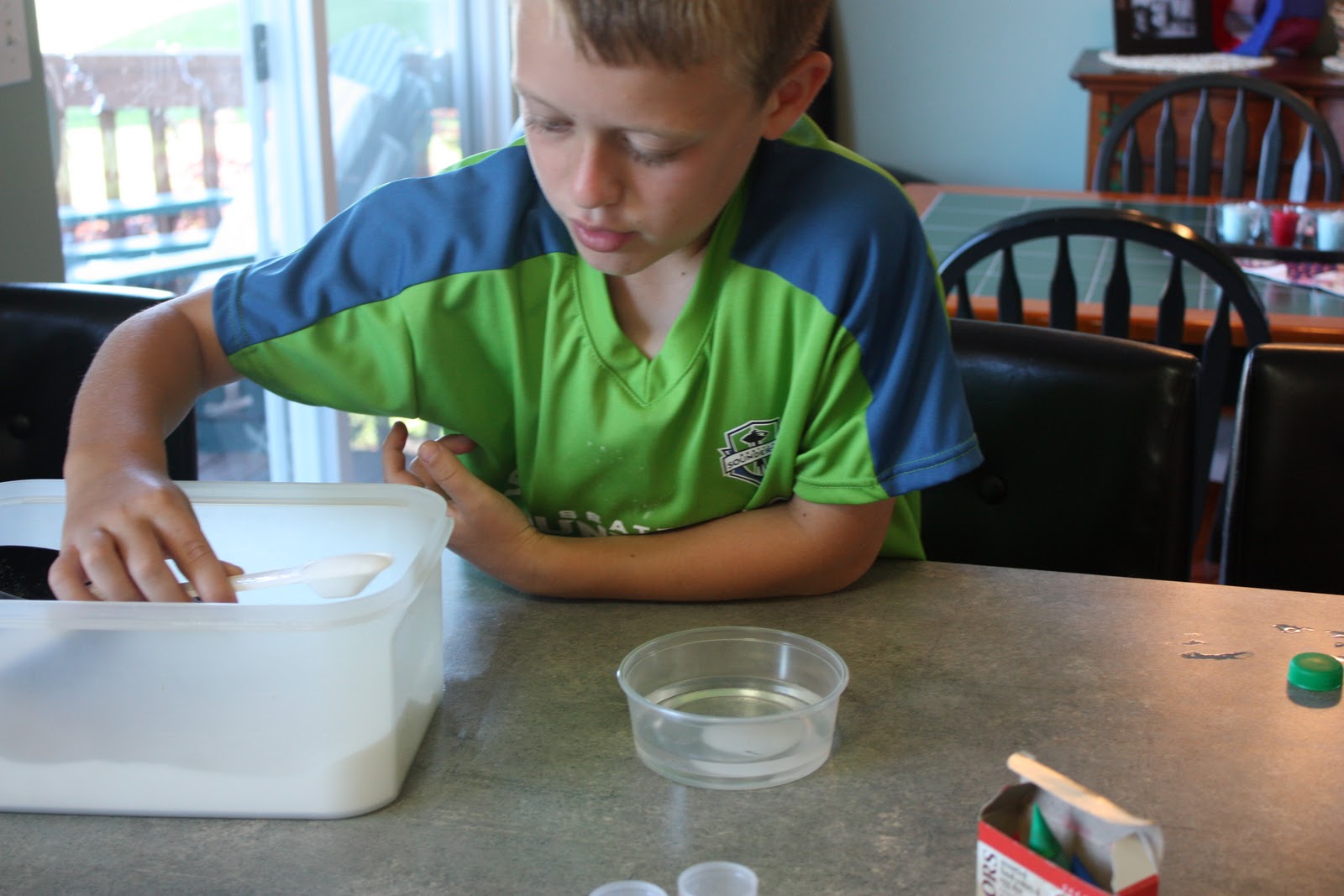
- Label each sugar solution with the amount of sugar. We wrote on the plastic container with a dry erase pen (it washes off very easily)

- Once each solution is stirred until all the sugar has dissolved, add a couple drops of food coloring. Each solution should be a different color

- The purpose of the exploration is to determine the relative density of each solution. Kid Scientists carefully try to layer the solutions into their film canisters. Adding the most dense solution first will allow a less dense solution to layer. Adding a less dense solution first causes the two to mix.

- Encourage your Kid Scientists with questions like...What happens when you put red on top of blue? What will happen if green is on top of yellow? Predict what happens if blue is in first, what would layer on top? What did you figure out about the green solution? The blue solution?

- Extension...try the same exploration with salt water solutions. What do you notice? What are the similarities? What are the differences?
Monday, June 28, 2010
Sorting...
Ages: This is designed for Little Kid Scientists, but there's nothing stopping the Big Kids from getting in on the fun
Materials: Shells, rocks, leaves...any group of items that are similar with identifiable differences

Purpose:
This activity is designed to introduce Little Kid Scientists to the idea of physical properties. Physical properties of matter can be observed or measured without changing what is being observed or measured. They include appearance, color, texture, odor, density and others. Later Kid Scientists will learn to distinguish between Physical Properties and Chemical Properties or use Physical Properties to identify something unknown. For now, this activity will start Kid Scientists thinking about ways to describe shells (or rocks, or leaves or flowers...)
Procedure:
Share the collection with your Kid Scientist, looking at each item.
Ask questions about what you're observing...How does that feel? What color is this? Is this bigger or is this one?
After you've observed all the shells in the jar, ask your Kid Scientist to put them into groups. "How many groups of shells can you make?" or "Can you sort the shells into different groups?"
Allow your Kid Scientist to sort the shells all by himself. Be supportive, and ask questions but allow him to do the thinking.
Once the shells are sorted, ask him to describe each group. "How did you decide which shells went into each group?"
You can help your Kid Scientist with new vocabulary by labeling the groups if he doesn't. "Oh, all these are small shells" or "So this is the group of shiny shells"

Subscribe to:
Posts (Atom)


