Monday, March 21, 2011

Science Project...

My Kid Scientist Connar came home last week with a science project assigned at school.  We're excited to share the project with you and challenge you to make your own.

Project:  Connar is studying ecosystems and evolution in school and his assignment was to create an organism.  At first, The Science Mommy wasn't too excited about the imaginary aspect of this project however, it did provide lots of opportunities for Connar to share what he knows about adaptations, food chains, and an organisms role within an ecosystem.
Procedure: Connar started out by thinking what he wanted his organism to look like...right away he had the idea to create a bio-luminescent creature {he really wanted to tap into his electricity kit}.  I asked lots of questions to help him decide where his organism lived and how it had adapted to that environment.
The creation of this organism was a challenge to Connar...he needed to use the saber saw to cut the dowel for legs, he used the drill to cut holes to anchor the legs, he salvaged an old toy for a switch and learned how to modify it to fit with another battery pack and he needed to figure out how to wire the light bulb to the switch and battery and install it into his organism.  There was more science at work here than meeting standard on an ecosystem project!  Finally after several assembly attempts, lots of glue and a couple of rounds with spray paint...
"Titano-aqua-saurus: this organism lives at the bottom of the ocean in an environment with very little light.  It's body coloring provides camoflage against the dark ocean floor.  It has a bio-luminescent rod to attract and hunt prey which are small fish.  Because it is dark, he doesn't have very good eyesight and relies on special cells in the large gills to smell prey. It also has armor, like a lobster as protection."

Now it's your turn...
  • Do a little research to find out what adaptations are and why they are important in understanding organisms. {There's a link in the sidebar!}
  • Create an organism using materials you have around your house.  While you are building your organism, consider where it lives.  What's the temperature?  How much water is available?  How much sunlight?  What other animals live in this area?  What shelter is available?
  • Make decisions in creating your organism that make sense for where, and how, it lives.  What does it eat?  What time of day is it most active?  How does it protect itself?
  • The Science Mommy would love to see what you create!


Monday, March 14, 2011

Forcing Bulbs...the Tulip Update...

Have you been working on the forcing bulbs investigation?  You can follow that link to the original investigation and get started right now!

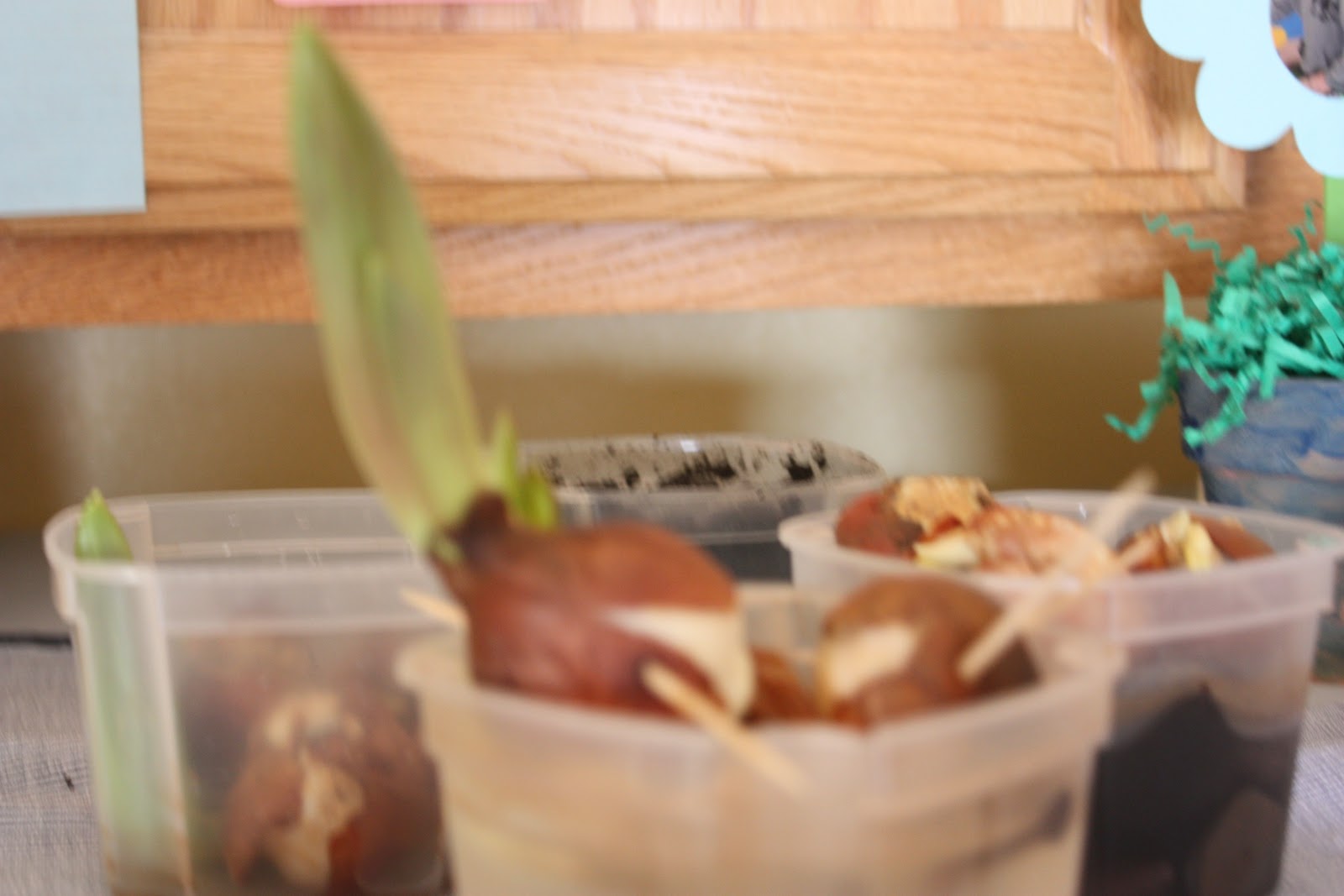
We are two weeks into our investigation, and for a while there it looked like we had made some miscalculations.  The bulbs were "started" on February 27, and it was on March 9 that we really saw some growth.  These pictures were all taken on March 12.

One of the bulbs that was propped on the edge of the container, with their tips in the water is doing the best. By best we mean that it has the most growth.
Also producing some stems are the bulbs that are just sitting in water.
The bulbs in rocks and water are much slower in responding than the others, but you can see that they are all starting to grow.
The photo is blurry, but the bulbs planted in the soil haven't done much at all.

My Science Kids are changing the water every three or four days, and making sure the bulbs in soil have moist soil.  They have predicted that we will have some flowers in about a week.

Monday, March 7, 2011

Volcanoes...

If you are following the experiment on Forcing Bulbs, stay tuned.  We will be publishing our results soon!


Did you know that on March 5,  a fissure opened on Kilauea's rift zone?  This fissure is still erupting lava...
Photo Credit:  Tim Orr, USGS, Science Daily

This recent volcanic activity inspired the Science Mommy to post a research investigation:
Ages: This one is for the Big Kid Scientists

Materials: Volcano resources - online or print.  This is a great opportunity to help your Kid Scientists learn to use a web browser to do a search, determine importance, and record their thoughts.  You can use this graphic organizer or something similar to help your Kid Scientist.

Procedure:
  • Choose an investigative question that interests you, or write your own.
  • Use the resources available to find information that will help you answer the question.
  • Find a way to share what you have learned.  Remember to report your findings in your own words and keep track of the resources that have helped you.
Alternate Procedure for Little Kid Scientists:
  • Find pictures of volcanoes - in magazines books, or online.
  • Invite your Little Kid Scientist to explore the pictures...they can sort the pictures, they can ask as many questions as they can think of about the pictures, they can talk with you about what they notice & wonder, they can choose one volcano and do some guided research with you...
Investigative Questions:
  • Where are the most active volcanoes in the world?
  • What is the difference between an active volcano and a dormant volcano?
  • How are volcanoes in different areas similar?  How are they different?
  • What makes the volcanoes in Hawaii unique?
  • How do geologists monitor volcanoes?  What data do they collect?  What do they do with the data?
  • How are earthquakes and volcanoes related?
The Science Mommy would love to hear what you learn about volcanoes!  
Have fun with your research!

Monday, February 28, 2011

Forcing Bulbs...

I don't know about you, but the Science Mommy is a little tired of the winter landscape.  This week's investigation, is a little selfish...I wanted something pretty and spring-like in my kitchen!
Ages:  This is best for the Big Kid Scientists
Materials: bulbs, various containers, rocks, soil, water
Procedure:
  • I presented an investigative question to my Kid Scientists...What is the best condition for forcing a bulb?  This required a bit of research before the boys were ready for the investigation.  They "googled" the question, and learned a bit about bulbs.  Your Kid Scientists can begin with their own research or you could use our ideas...
  • Once the boys had a couple of ideas, they gathered the additional materials they needed. 
  • Connar's first plan was to plant the bulbs in potting soil with water.  He plans to check the soil every day and make sure it's moist.
  • Aiden's found a diagram of a bulb suspended over water online.  He used toothpicks to balance the bulb on the edges of the plastic container.  He'll check every day to make sure the water covers the bottom of the bulb.
  • This container has just water with the bulbs floating
  • The final container is 1/2 full of rocks and water.  The bulbs are wedged into the rocks.
  • Each Kid Scientist recorded his predictions regarding which container would be the best for forcing the bulbs to bloom and which one wouldn't work at all.  We also recorded the starting date.

Finally, the bulbs in containers were left on top of the refrigerator.  This will ensure that the water doesn't spill and our cats don't help with the investigation.
We will keep you posted on the details of our investigation.  The Science Mommy would love to hear about yours!

Sunday, February 27, 2011

An Award...

How exciting!  The Science Mommy has just received an award from Be Our Best...
This is a first for The Science Mommy and I am very thankful and appreciate the recognition.  There are, of course, a couple of rules in order to accept this award...
#1 - 4 Guilty Pleasures...
Hmmm...as this isn't my personal blog, it feels a bit odd to share guilty pleasures.  So, I thought I would take a little liberty in my interpretation of the rules. {After all rules are more like guidelines aren't they?}
#1 - 4 Fun Science Facts...
Yes, this feels more appropriate for the Science Mommy!

1 - In 1822, geologist William Buckland discovered some really big teeth in England.  He didn't have a name yet for his discovery, but they were the first artifacts of dinosaurs.

2 - In 1674 Anton Van Leeuwenhoek discovered microorganisms in a drop of water.

3 - In 1666 Isaac Newton came to the conclusion that all objects in the universe, from apples to planets, exert gravitational attraction on each other.

4 - The double-helix structure of DNA was discovered in 1953 by James Watson and Francis Crick.  The length of a single human DNA molecule, when extended, is 1.7 meters.

#2 Six Wonderful Blogs to Pass this Award on...{in no particular order}
3 Moms in 1
Discover their Gifts
Our Worldwide Classroom
Learning is Child's Play
Giving up on a Clean House
Wonderland Homeschool

Take a peek at those blogs...they are all about teaching, kids and the magic that happens when the two come together!

Monday, February 21, 2011

Tangrams...

My oldest Kid Scientist, was working on a large project for school when we discovered pages of tangram puzzles online.  These are fantastic puzzles for Kid Scientists of all ages...helping to build critical thinking, creative thinking and problem solving skills.  Whether you make your own tangrams like Connar, or click around with the internet puzzles...these will hook you!

Ages:   This is for the Big Kid Scientists

Materials: If you make your own you will need a tangram pattern, a saber saw and some 3/4" wood.  You can also use 1/8" foam, cardstock or any other material you have on hand.

Procedure:

  • Print out the tangram pattern.  This is a universal pattern and you can enlarge it if you'd like, as long as you enlarge all the pieces equally.
  • Cut out the pieces and trace them onto the building material you'll be using.
  • Carefully cut out the pieces.  As these are puzzle pieces, it's important to keep the lines straight and maintain the dimensions of the shape. 
  •  We used a saber saw to cut the puzzle pieces out of the wood.  This was also a great opportunity to teach Connar how to use the saw.  There aren't any pictures, because The Science Mommy needed to help hold the wood and "steer" the saw.  Connar had never used this saw before and he was excited try it out.

  • Once the pieces are cut out, located tangram shapes online and do your best to arrange the pieces so they form the shape.  Most of the shapes aren't nearly as easy to create as they appear!
 Have Fun with your tangrams!

Monday, February 14, 2011

More Books for Kid Scientists...

My Kid Scientist Aiden, has been busy reading.  In fact, he's currently reading everything in sight.  We wanted to share some of his current favorite science books...

Winter's Tail: How One Little Dolphin Learned to Swim  by Juliana Hatkoff.  This amazing story is about a young dolphin who became entangled in the lines of a crab pot.  Though she was rescued and survived, the blood supply to her tail was compromised and she ended up losing her tail.  Through the donations and work of many people, a prosthetic tail was built for Winter.  This is a fantastic story and the photographs throughout the book are amazing.  Aiden loves this book and I am sure you're Kid Scientists will as well.
The Magic Tree House - Research Guides by Mary Pope Osborne.  This is a brilliant series for young readers and Aiden is equally compelled by the Research Guides as the fictional stories.  The magic tree house allows the two young characters, Jack and Annie, to travel through time in search of various clues.  The best part of the story is the historical or geographical setting and the interesting information that is shared with young readers.  Many of the fictional books have research guide companions.  Here the author shares the background knowledge she learned while writing the fictional story.  These are great tools for helping young readers understand the difference between fiction and non-fiction, and the settings of the stories are extremely engaging.  Aiden asked me to pass on, "I think everybody should read these books because they teach you so much and they are fun to read."
What do your Kid Scientists enjoy reading?